
The Volunteer Slavery of Modern Music
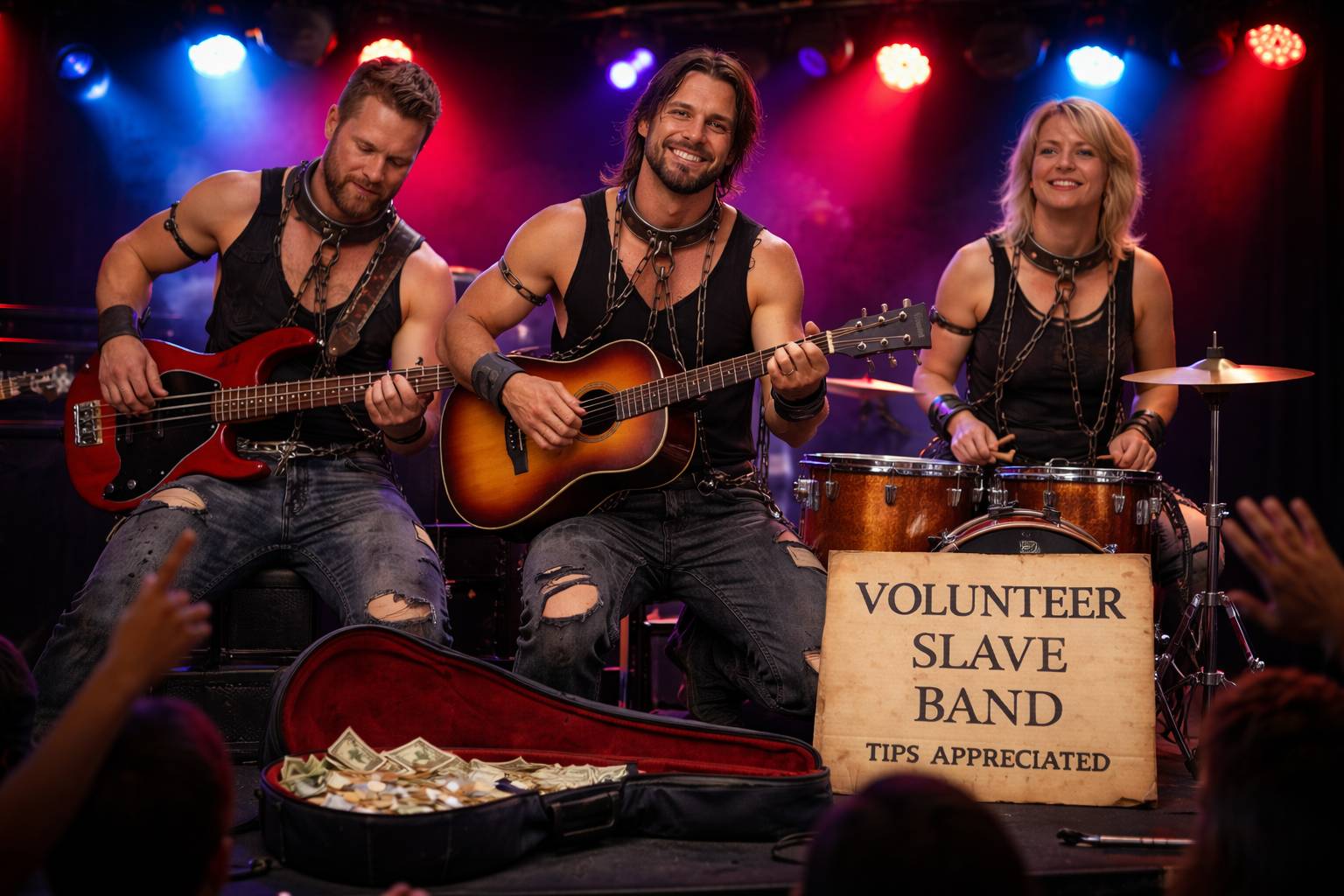
How the streaming economy captured an entire workforce — and convinced them to be grateful for it.
The phrase "volunteer slavery" sounds like a contradiction. Slavery, by definition, is not chosen. And yet it captures something precise about the structural position of working musicians in today's industry: a system in which labor is freely given, the choice to participate is technically real, and the alternative — invisibility — is so unacceptable that the choice is no choice at all.
This is not a new observation, but it deserves careful unpacking. The music industry's transformation over the past two decades has been routinely framed as democratization — more artists, more access, more listeners, borders dissolved. What has received less attention is how that democratization redistributed power, and who wound up holding it.
The Illusion of the Open Door
The streaming era's promise was simple: artists no longer needed gatekeepers. No label, no distributor, no radio programmer standing between a musician and an audience. Anyone could upload a track to Spotify, Apple Music, or Tidal and be heard anywhere on earth within hours.
This is true as far as it goes. The gate is, formally, open. But once you walk through it, you are operating on someone else's platform, under someone else's rules, compensated at rates that someone else sets — with no meaningful power to negotiate any of it.
Streaming now accounts for roughly 84% of recorded music revenue. Spotify alone commands an audience of more than 100 million Americans — nearly double its nearest competitor. For a musician, opting out of these platforms is not a principled stand; it is professional suicide. The "choice" to participate is, structurally, coercion wearing a terms-of-service agreement.
What the Work Is Worth
The mechanics of compensation are where the labor analogy sharpens. Spotify pays an average of roughly $0.004 per stream. An artist needs approximately 250 streams to earn a single dollar. A modest monthly listener base of 10,000 people — which would represent genuine success for most independent musicians — generates in the neighborhood of $400 per month, before any split with a label, distributor, or collaborators.
Meanwhile, Spotify reported revenues in the billions. The platform is valued in the tens of billions. The music — the content that makes any of this worth anything — is provided almost entirely by the people earning $400 a month.
There is a category of artist who does well under this model: the superstar. For an artist with hundreds of millions of streams, the fractions accumulate into real money. But the superstar was never the musician in need of structural protection. The people the old model exploited, and the new model continues to exploit, are the working musicians — the ones who make a living, or try to, at the middle and lower registers of the industry.
The Invisible Workforce
There is a workforce even more invisible than the independent artist: the session musician. The drummer who played on the album. The string arranger. The background vocalist whose voice is on every chorus. A UN/WIPO report found that non-featured performers receive nothing from streaming royalties. Not a reduced rate. Nothing.
These musicians are professionals. They trained for years. They showed up to sessions. Their labor is embedded in the recordings that generate the revenue. They were paid a flat fee once, if at all, and that fee bought their participation forever, on any platform, at any scale, without further compensation.
The Data No One Talks About
Every time a listener plays a track on Spotify, the platform learns something: what they were doing, where they were, what they listened to next, how long they listened, when they skipped. This behavioral data is extraordinarily valuable. It powers recommendation algorithms, informs advertising rates, and contributes to a platform valuation that has nothing directly to do with music.
The artists whose tracks generate all of this data see none of the value it creates. They are not just providing content. They are providing the raw material that makes the platform intelligent — and they receive no compensation for this secondary contribution
Pay to Play, Rebranded
Spotify's Discovery Mode offers artists priority placement in algorithmic playlists in exchange for accepting a reduced royalty rate. Radio stations were legally prohibited from accepting payment for airplay — payola — after congressional investigations in the 1950s revealed it was distorting what listeners heard. Streaming platforms face no equivalent prohibition. Discovery Mode is, structurally, an artist paying for exposure with their own future earnings.
In 2025, new licensing thresholds mean that tracks receiving fewer than 1,000 streams in a given period are excluded from royalty distribution entirely. The effect is to exclude most independent and emerging artists from any compensation regardless of the effort behind their work.
The Eleventh Consecutive Year of Growth
Global recorded music revenues reached $31.7 billion in 2025 — the eleventh straight year of industry growth. The money is there. The industry is not in crisis. The platforms are profitable. The labels are profitable. The question is not whether the music business generates value. It is how that value is distributed, and why the people who create it are systematically positioned to capture the least of it.
Why "Volunteer" Is the Right Word
The genius of this system — if genius is the right word — is that it requires no compulsion. No one forces musicians to upload their work. The exploitation is structurally induced rather than directly imposed, which makes it much harder to name and much easier to defend.
A musician who complains is told they are free to leave. A musician who leaves disappears. The "freedom" offered is the freedom to accept the terms or accept irrelevance. It is the same freedom offered by every monopoly to everyone who depends on it.
The result is a workforce that shows up willingly, works without adequate compensation, generates value it does not capture, and has no practical exit. The coercion is real. The voluntariness is real. Both things are true at once — which is what makes "volunteer slavery" not a provocation, but a description.
of this requires ascribing malice to any individual executive or platform. These are structural outcomes produced by market concentration, weak labor protections for musicians, and the specific economics of near-zero marginal distribution costs. The system does not need villains. It just needs no one to change it.
And so far, no one has.